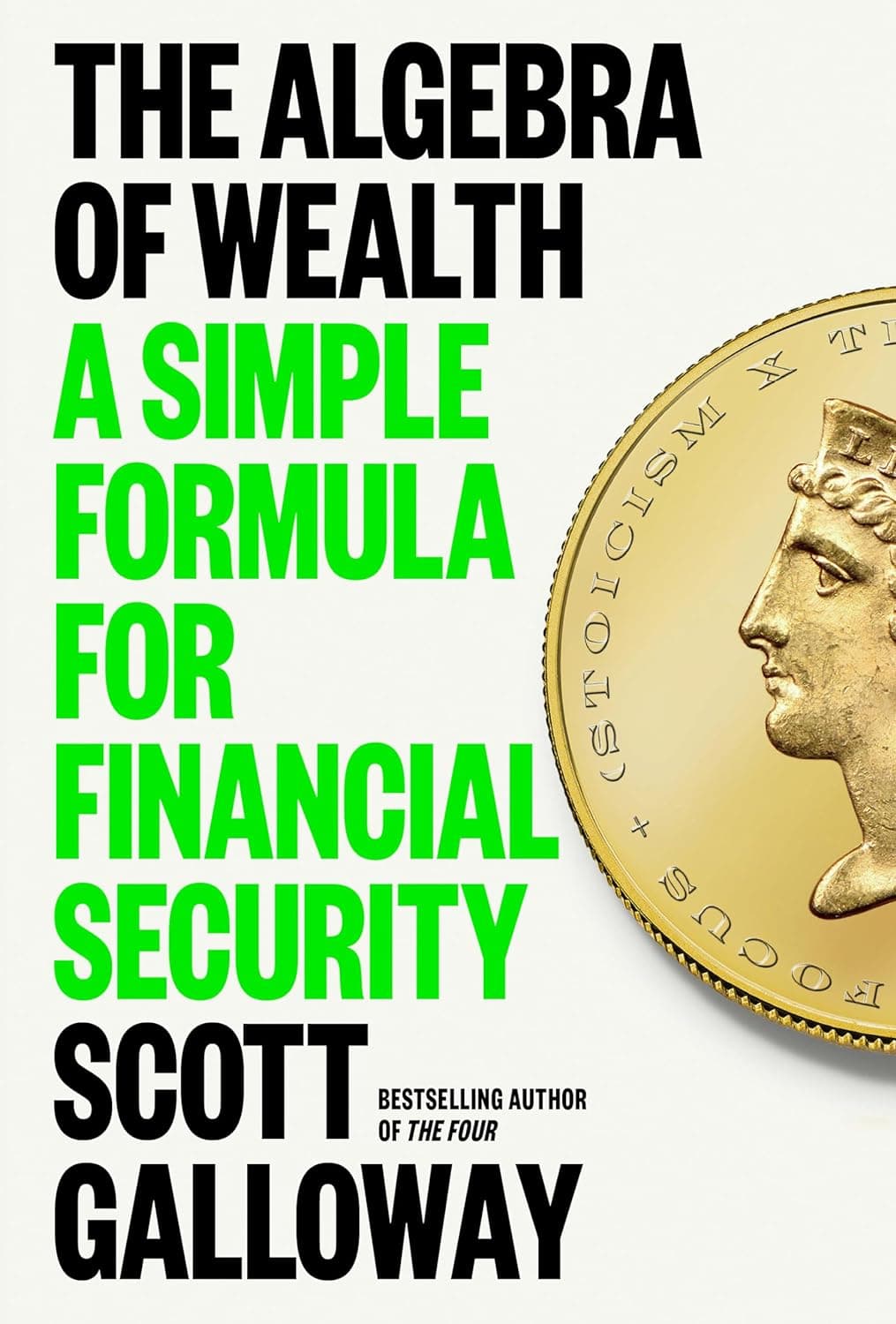
The Algebra of Wealth — Scott Galloway
Impressions
The early chapters on focus and stoicism are the strongest parts of the book. Galloway's insistence that "follow your passion" is genuinely bad advice for most people is correct and underargued elsewhere. The mechanism he proposes instead, follow your talent into markets with tailwinds, then let economic security enable passion, is more honest about how most successful people actually built their lives.
The investment chapters are competent but cover well-worn ground. If you have read anything serious about index investing, you will not find new information there. The real value is in the framing chapters, not the mechanics.
I found the tone occasionally self-congratulatory. Galloway writes like someone who has already won, which is sometimes useful and sometimes grating. The book is better when he is being prescriptive than when he is being autobiographical.
Who Should Read It?
- Anyone in their twenties or early thirties who earns a reasonable income but has not built meaningful savings.
- People who have spent years chasing passion in low-paying fields and are questioning whether that was the right frame.
- Anyone who intellectually knows they should invest more but keeps finding reasons not to start.
- People who conflate net worth with income and do not understand why high earners stay broke.
How the Book Changed Me
I stopped treating spending as a reward for hard work. Before reading this, I treated consumption as a reasonable consequence of earning. Galloway's framing of stoicism as a competitive advantage reframed it: every dollar spent on a signal is a dollar that cannot compound. That is not a moral argument. It is an arithmetic one.
I also got more concrete about serializing risk. I used to think that taking multiple risks simultaneously was bold. Galloway's point that stacking risks is a fast way to lose everything made me sequence decisions more deliberately. Build economic security first. Then take the swings.
My Top 3 Quotes
"The most important financial decision you will make is choosing a life partner. Not your asset allocation. Not which stocks you pick. Your partner."
I had never seen this framed as a financial decision before. It is obvious in hindsight. Spending habits, risk tolerance, and savings behavior are the product of two people, not one.
"Don't follow your passion. Follow your talent. Let passion follow."
This is the cleanest version of an argument that most career advice gets backwards. Passion is the output of mastery and economic security, not the input. Treating it as the input produces people who are broke and miserable in jobs they love.
"Time is the asset. Not money. Money without time is a limited resource. Time without money is a solvable problem."
This reordered how I think about financial urgency. The reason to start early is not just compound interest. It is that starting early is the only thing that cannot be replicated with effort later.
Summary + Notes
Part I — Focus
What does Galloway mean by focus?
Focus is not a productivity concept here. It is an economic one. Galloway uses focus to mean: directing your working years toward fields and roles that pay, rather than spreading effort across pursuits that feel meaningful but do not compound economically.
The underlying argument is that economic security is a prerequisite for almost everything else people claim to want: freedom, creativity, risk-taking, relationships, health. Without it, those things become contingent on luck. With it, they become choices.
Why is "follow your passion" bad advice?
Passion is outcome-dependent. You cannot feel passionate about something you are not yet good at, and you cannot get good at something without sustained effort through long periods of mediocrity. Telling someone to follow passion before they have any skill is telling them to expect a feeling that requires years of work to arrive.
The better frame is: follow your talent. Find what you are disproportionately good at relative to peers, then find markets where that talent is valued and growing. Over time, mastery produces passion. Passion does not produce mastery.
Galloway adds a second component: pick industries with tailwinds. Talent deployed in a contracting market is harder work for less return. Talent in a growing market compounds on multiple dimensions.
What does it mean to serialize risk?
Most people think risk tolerance is binary: either you are bold or you are not. Galloway distinguishes between stacking risks and sequencing them.
Stacking risks means taking multiple large bets simultaneously: starting a company, renting an expensive apartment, having children, and carrying debt at the same time. Any one of those bets failing can cascade into the others. The aggregate exposure is enormous.
Serializing risk means completing one phase before beginning the next. Build economic security before starting the company. Pay down debt before expanding lifestyle. Take the swing after the foundation is stable.
This is not conservatism. It is sequencing. Galloway took significant risks throughout his career, but the argument is that the order in which you take them determines whether a failure is survivable.
What role does character play in building wealth?
Galloway identifies three character traits that predict wealth more reliably than intelligence or credentials:
- Accountability. Taking ownership of outcomes rather than attributing them to circumstance. People who blame bad luck do not learn from failure.
- Hustle. Not working hard for its own sake, but being willing to do more than is required when the opportunity warrants it.
- Frugality. Spending less than you earn, consistently, regardless of income level.
He is explicit that frugality is the rarest of the three. Income rises for most professionals over time. Spending rises faster. The gap between what is earned and what is kept is not a function of salary. It is a function of discipline.
Part II — Stoicism
What is stoicism in the context of personal finance?
Stoicism here is not a philosophy seminar topic. Galloway uses it to mean control over your wants. The ability to not spend money you have. The capacity to distinguish between what you actually need and what you have been persuaded to need.
Consumer capitalism is engineered to convert income into spending. Brands exist to make you feel that ownership of a product upgrades your identity. The response Galloway recommends is not asceticism. It is indifference: a practiced ability to observe the want, recognize the mechanism producing it, and choose not to act.
How does lifestyle inflation destroy wealth?
Every raise is also a decision. Most people upgrade their lifestyle to match each income increase: a better apartment, a better car, better restaurants. The result is that income rises but savings stay flat. The person earning two or three times what they earned five years ago is no wealthier in any durable sense.
Galloway calls this the hedonic treadmill. More is required to produce the same feeling of adequacy. The only exit from it is a deliberate decision not to let spending track income.
The people who build wealth do not feel rich. They live below what their income would permit. That gap between what they earn and what they spend is the source of everything.
Why do signals of wealth undermine actual wealth?
Spending on visible status (luxury goods, expensive cars, prestigious addresses) is spending that cannot compound. That is the arithmetic argument. The psychological argument is that status spending is reactive. It is driven by comparison to others, which means the target is always moving and the spending never resolves the underlying anxiety.
Galloway is direct about this: the people who appear wealthy and the people who are wealthy are often different people. Real net worth is invisible. It is shares in index funds and paid-off property. It is not visible enough to perform.
Part III — Time
Why does starting early matter more than earning more?
Compound growth is time-dependent in a way that is not intuitive. The gains are not linear. They are exponential, and the largest gains occur at the end of long compounding periods. A dollar invested at twenty-five and left alone is worth multiples of a dollar invested at thirty-five, even if the person who started later contributes more.
This means that starting late cannot be fully compensated by working harder or earning more. Time is the input that cannot be purchased retroactively.
Galloway's practical implication: make any investment, even a small one, as early as possible. The size matters less than the starting date.
What does time have to do with career decisions?
The same logic applies to skill development and career positioning. Skills compound. The person who develops a rare, valuable skill early and then applies it for decades builds expertise that is nearly impossible to replicate quickly.
The careers that pay the most tend to be careers where early decisions locked in compounding advantages: choosing the right field, the right city, the right firm, the right relationships. These advantages are not permanent, but they are hard to rebuild from scratch at forty.
Part IV — Diversification
What does diversification mean beyond investments?
The standard financial advice on diversification (hold index funds, do not concentrate in single stocks) is correct and Galloway endorses it. But he extends the concept beyond investment portfolios.
Diversification of income means not depending on a single employer, client, or skill set. A person with one employer, one skill, and no savings is maximally exposed. A job loss is a financial crisis, not a setback.
Diversification of relationships means investing in multiple kinds of connection: professional network, close friendships, family. People with thin social networks are more fragile in ways that show up eventually.
How do relationships determine financial outcomes?
This is the section most personal finance books skip. Galloway is direct about it: the single most important financial decision most people make is who they partner with. A partner who spends above their means negates savings discipline. A partner who shares financial values multiplies it.
The second relationship argument is about network. High-earning careers are rarely found in isolation. They are found through people who know you, trust you, and think of you when opportunities appear. Networking is not a professional activity. It is an ongoing investment that pays compounding returns over time.
What is the role of luck, and how do you position for it?
Galloway does not dismiss luck. He argues that luck is real, that it played a significant role in his own success, and that pretending otherwise is dishonest.
But luck is not evenly distributed. Being in the right city, working in the right industry, staying visible to the right people, and staying solvent during market downturns are all ways to increase the probability of being in the path of a good opportunity when one arrives.
Luck favors the prepared and the present. The preparation is skill and financial stability. The presence is showing up, consistently, in places where opportunities concentrate.
Conclusion
What is wealth actually for?
Galloway ends with a question most personal finance books do not ask. Wealth is not the goal. It is the foundation. The goal is a life with freedom, deep relationships, and health that is not held hostage by financial fragility.
The people who optimize for wealth as an end, accumulating past the point of any practical use, have confused the instrument for the purpose. The people who ignore it entirely discover that its absence constrains everything they actually care about.
The algebra of the title is not complicated:
Wealth = Focus x (Stoicism + Time + Diversification)
Each variable is available to most people. The constraint is character, not circumstance.