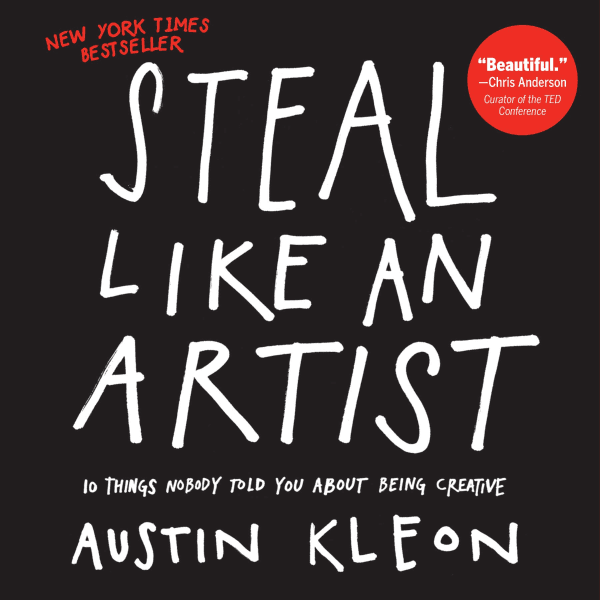
Steal Like an Artist — Austin Kleon
All advice is autobiographical — whenever people give advice, they're really just talking to themselves in the past.
This book is short, punchy, and liberating. Kleon's argument is that creativity is not about being original from thin air — it is about being honest about your influences, learning from them deliberately, and eventually combining them into something that feels like yours.
Impressions
A surprisingly practical and freeing read. It does not romanticise creativity as some rare gift — it treats it as a set of habits and attitudes anyone can adopt. Best read in a single sitting.
Who Should Read It?
Anyone who creates — writers, designers, engineers, musicians — and feels blocked by the pressure to be "original." Also good for people who are waiting to feel ready before starting.
How the Book Changed Me
It gave me permission to borrow ideas openly and without guilt, as long as I transform them and give credit. It also pushed me to start sharing work before it felt polished enough.
My Top 3 Quotes
"The artist is a collector. Not a hoarder — hoarders collect indiscriminately, artists collect selectively."
"Fake it till you make it. I know, I know, everyone hates this advice. But it works."
"The work you do while you procrastinate is probably the work you should be doing for the rest of your life." — Jessica Hische
Summary + Notes
Chapter 1 — Steal Like an Artist
Nothing is original
The anxiety of originality is misplaced. Every idea is a remix. Every creator is downstream of influences. The question is not whether you are influenced — you always are — but whether you are honest about it and whether you are doing something interesting with what you absorb.
"What is originality? Undetected plagiarism." — William Ralph Inge
Kleon quotes T.S. Eliot: "Immature poets imitate; mature poets steal." The distinction is not between borrowing and not borrowing — it is between borrowing poorly and borrowing well.
The genealogy of ideas
No idea comes from nowhere. Every creative work has ancestors. Trace any concept, style, or technique far enough back and you will find that it was itself assembled from earlier influences.
Understanding this is not demoralising — it is liberating. It means you do not need to invent something from scratch. You need to find the right lineage to place yourself in, learn from the best of it, and add your own voice.
Garbage in, garbage out
What you consume shapes what you create. If you only read mediocre work, you will produce mediocre work. If you expose yourself to the best — the most ambitious, the most original, the most technically accomplished — it raises your internal standard.
Be selective about your inputs. Read widely but also deeply. Collect what genuinely moves you, not what you think you should be impressed by.
School yourself
Formal education is optional. Self-directed learning is not. The best creators are relentless self-educators — they identify who they want to learn from and then systematically study that person's influences, methods, and decisions.
Kleon calls this "climbing your own family tree." You find an artist you love, then you find who they loved, then who that person loved — and suddenly you have a rich, interconnected web of influence to draw from.
Chapter 2 — Don't Wait Until You Know Who You Are to Get Started
Fake it till you make it
You do not have to feel like an artist to act like one. Identity follows action, not the other way around. Start doing the work of the person you want to become, and the sense of identity will follow.
This is not about deceiving anyone. It is about recognising that nobody starts with a fully formed sense of self. You figure out who you are by trying things.
Start copying
The way every creative person learns is by copying — consciously or not. You absorb the styles of people you admire, you imitate their techniques, and through that process you develop taste and skill.
The key is to copy in order to understand, not to pass the copy off as your own work. Copy by hand, not by Ctrl+C. When you physically recreate something, you understand how it was made in a way that passive consumption never gives you.
Over time, copying from multiple sources produces something that starts to look like your own voice — because it is a combination that only you could have assembled.
Bad theft vs good theft
| Bad theft | Good theft |
|---|---|
| Plagiarise | Transform |
| Imitate | Emulate |
| Steal from one | Steal from many |
| Credit yourself | Credit your sources |
| Degrade | Improve |
The difference between a plagiarist and an artist is transformation. The plagiarist takes and reproduces. The artist takes and changes — adds something, subtracts something, recombines in a way the original creator never intended.
Chapter 4 — Use Your Hands
Step away from the screen
Digital tools are powerful but they create a certain kind of distance from the work. There is something different about making things with your hands — sketching, writing by hand, building physical prototypes — that changes how you think.
Physical making engages the body and slows the process down in a productive way. It also keeps you off the internet, which is where most creative energy goes to die.
Kleon keeps two desks: a digital desk with a computer, and an analogue desk with paper, pens, and scissors. The analogue desk is for generating. The digital desk is for refining and publishing.
The lesson is not to abandon technology — it is to not let technology be the only medium you work in. Your best ideas often appear when your hands are busy and your screen is dark.
Chapter 5 — Side Projects and Hobbies Are Important
"The work you do while you procrastinate is probably the work you should be doing for the rest of your life." — Jessica Hische
Practice productive procrastination
When you are stuck on one thing, the instinct is to force yourself back to it. But sometimes the best thing to do is work on something else — something low-stakes, playful, or completely unrelated.
Side projects give you a place to experiment without consequences. The discoveries you make there often feed back into your main work in unexpected ways. Many major creative breakthroughs came from things that started as distractions.
Don't throw any of yourself away
It is tempting to compartmentalise — to decide that the "serious" version of you only works on serious things, and everything else is a waste of time. This is wrong.
Your interests, even the ones that seem irrelevant, make you who you are. A programmer who also paints brings something to their programming that a programmer who only codes does not. A writer who also runs brings something to their writing that a writer who only sits brings nothing to.
Keep all of yourself active. The connections between your different interests are where your most distinctive work will emerge.
Chapter 6 — Do Good Work and Share It with People
The not-so-secret formula
- Wonder at something.
- Invite others to wonder with you.
That is it. Create work that genuinely interests you, and then share it. The sharing is not optional — it is how you find your audience, get feedback, and build the relationships that sustain a creative life.
Project lifecycle
Every project has a lifecycle: idea, development, finished work, sharing. Most people invest heavily in the first three stages and almost nothing in the last. But sharing is where the work lives in the world.
Sharing is not bragging. It is being generous with what you have made.
If you are worried about giving your secrets away
Share your process, not just your results. People are fascinated by how things are made — the decisions, the dead ends, the iteration. Showing your work in progress builds an audience before the final product is finished.
Also: your "secrets" are less secret than you think. The thing that makes your work distinctive is not a technique that can be copied — it is you. Share freely.
Chapter 7 — Geography Is No Longer Our Master
Build your own world
You do not have to move to a creative capital to be a creative person. The internet has collapsed geography in a way that would have been unimaginable to previous generations. You can find your people, learn from masters, and publish your work from anywhere.
This means that the barriers that once existed based on where you were born or where you could afford to live are mostly gone. The barrier that remains is doing the work.
Leave home!
At the same time — travel. Leave your familiar environment. Discomfort and novelty are generative. Seeing how other people live, what other places look and feel like, introduces inputs that your home environment cannot provide.
The tension between these two pieces of advice is intentional: build a stable home base and a consistent practice, but also expose yourself to the world outside it. Both are necessary.
Chapter 8 — Be Nice (The World Is a Small Town)
Stand next to the talent
The people you spend time with shape what you become. Surround yourself with people who are doing interesting work, who are more skilled than you in domains you want to develop, who make you feel like you need to raise your game.
Creative communities are small. The person you dismiss rudely today will be the editor, the collaborator, or the investor you need in five years. Be generous, be curious, and be kind.
Validation is for parking
Do not make your creative practice contingent on external approval. Validation feels good but it is an unreliable source of fuel. The work has to be its own reward — otherwise you will stop the moment the audience is not enthusiastic enough.
Make work that you would want to exist in the world, regardless of whether it finds an audience. The audience usually follows, eventually.
Chapter 9 — Be Boring (It's the Only Way to Get Work Done)
Stay out of debt
Financial precarity kills creative freedom. When you are worried about money, you cannot afford to take risks, turn down bad projects, or wait for the right opportunity. The most boring possible financial advice — spend less than you earn, avoid debt, build a cushion — is also the most liberating creative advice.
Marry well
More broadly: the people you surround yourself with in your personal life directly affect your creative output. A partner who supports your work, understands your commitment to it, and does not resent the time it takes is one of the most important creative assets you can have.
The same applies to friendships. Spend time with people who energise you and let go of the ones who consistently drain you.
Stability at home — emotional, financial, relational — creates the conditions for creative risk-taking. It is not glamorous, but it is true.
Chapter 10 — Creativity Is Subtraction
Choose what to leave out
Constraints are not the enemy of creativity — they are often the source of it. When you have unlimited options, paralysis sets in. When you have a container — a word count, a format, a deadline, a set of rules you have imposed on yourself — you are forced to make choices.
Those choices are where your voice emerges.
The most common creative mistake is not leaving enough out. Writers who cannot cut, designers who cannot simplify, programmers who cannot delete — all are failing at the discipline of subtraction.
"A designer knows he has achieved perfection not when there is nothing left to add, but when there is nothing left to take away." — Antoine de Saint-Exupéry
What now?
Start making something. Do not wait until you feel ready — you will not feel ready. Do not wait until you know who you are — you will figure that out by working.
Steal from the right places. Transform what you take. Share what you make. Repeat.